Lenard, P. [E. A. von]
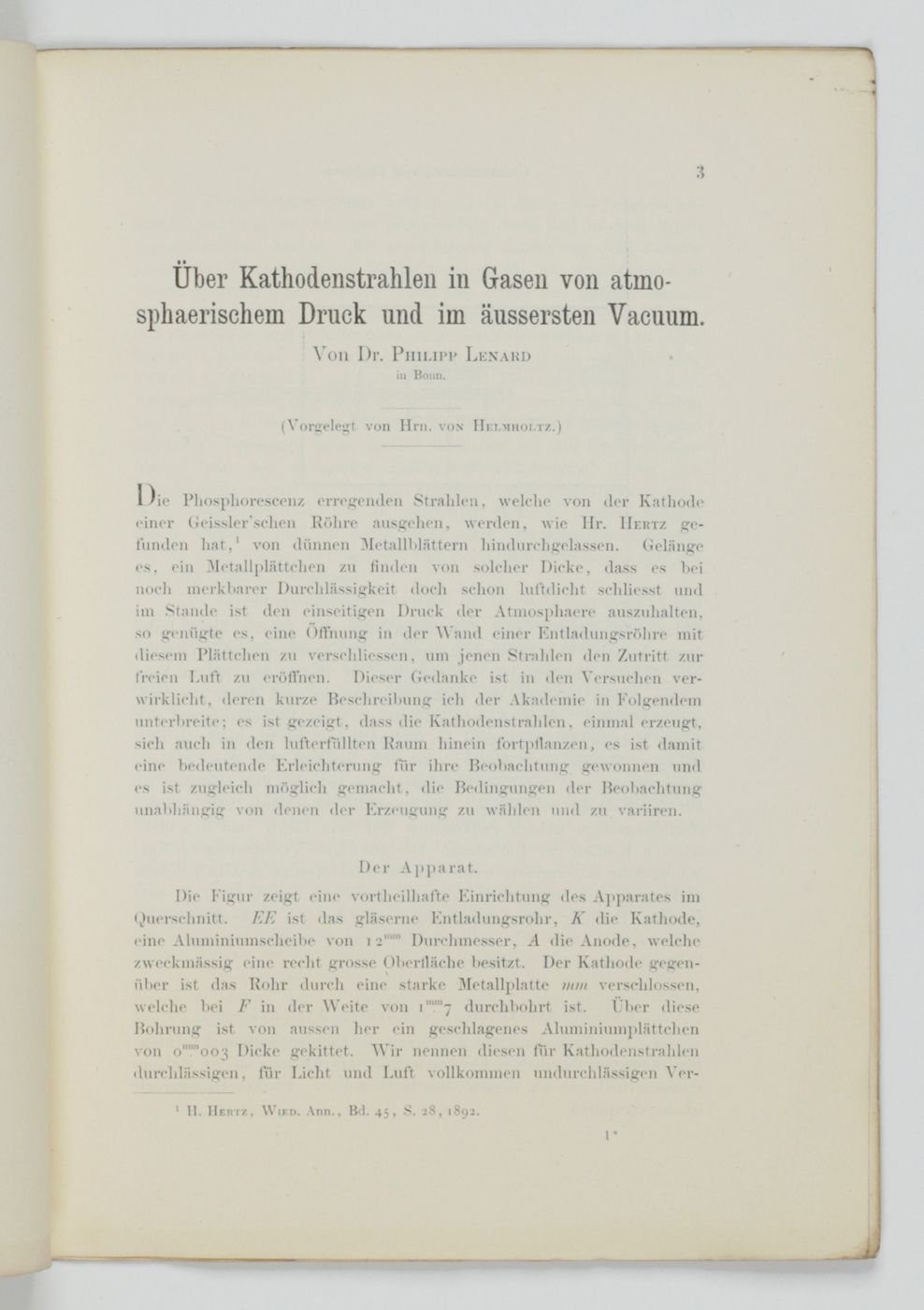
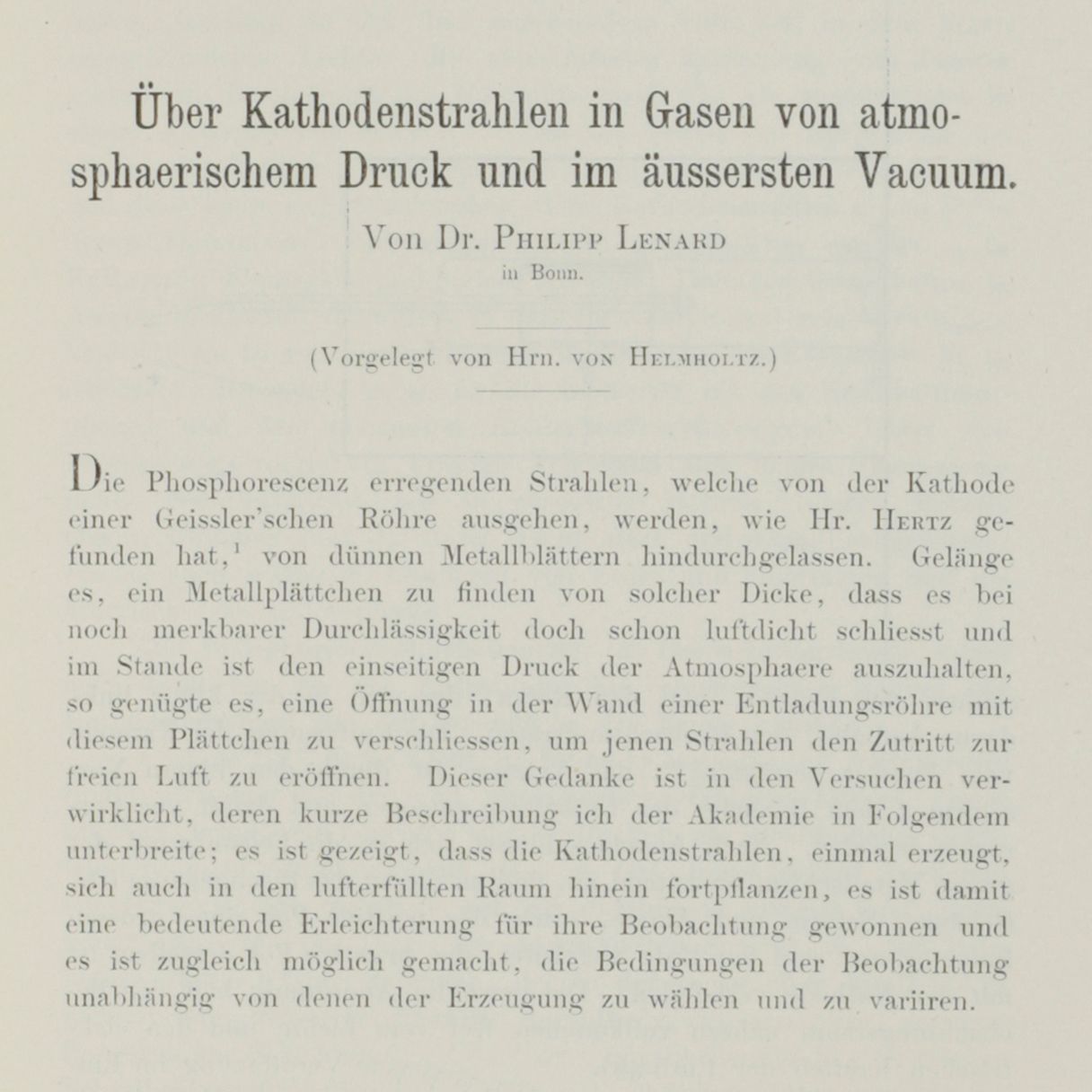
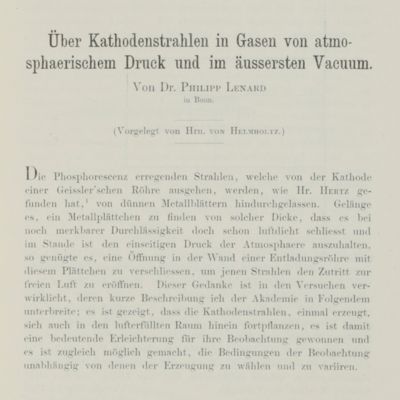
Über Kathodenstrahlen in Gasen von Atmosphaerischem Druck und im äussersten Vacuum.
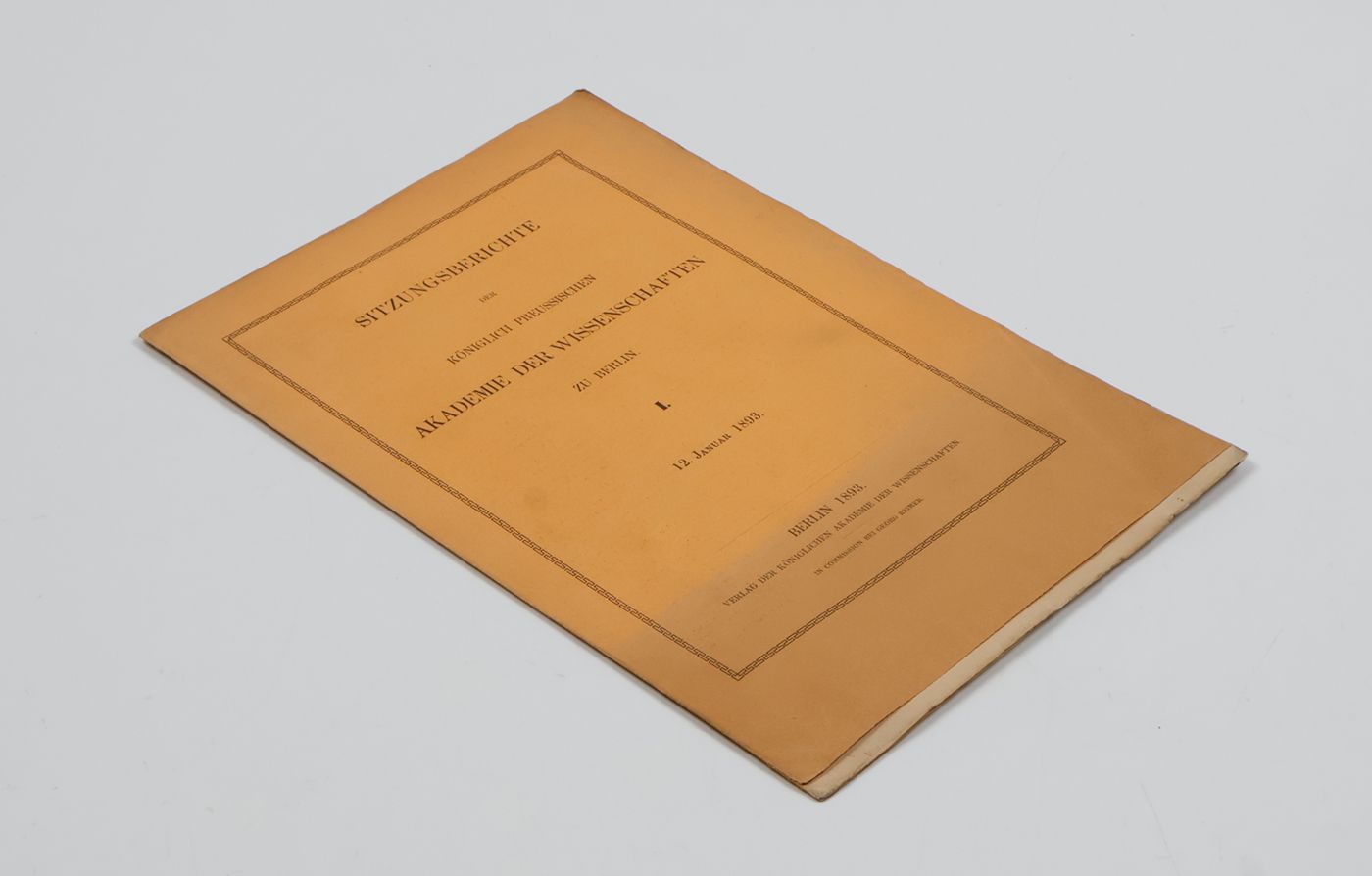
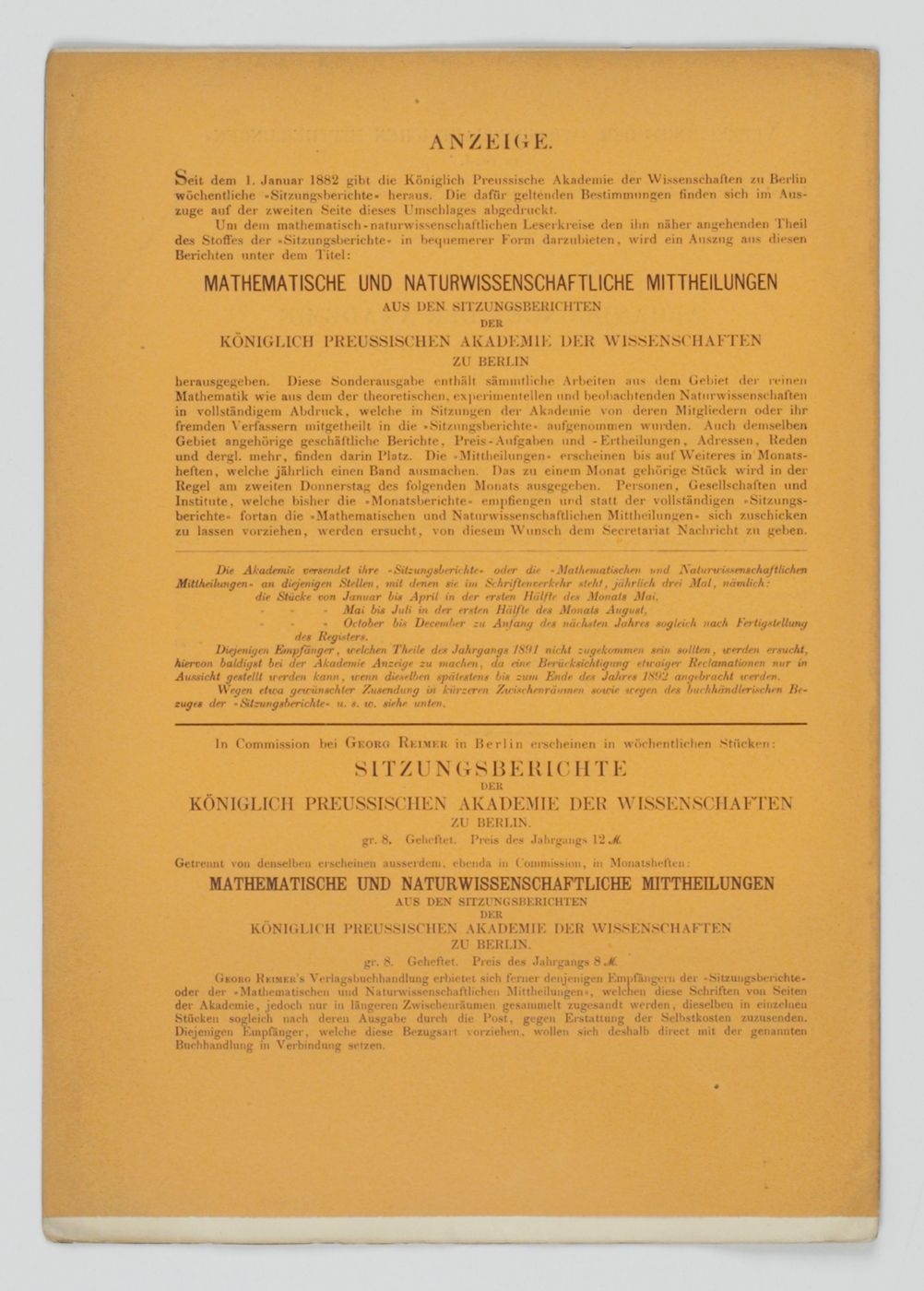
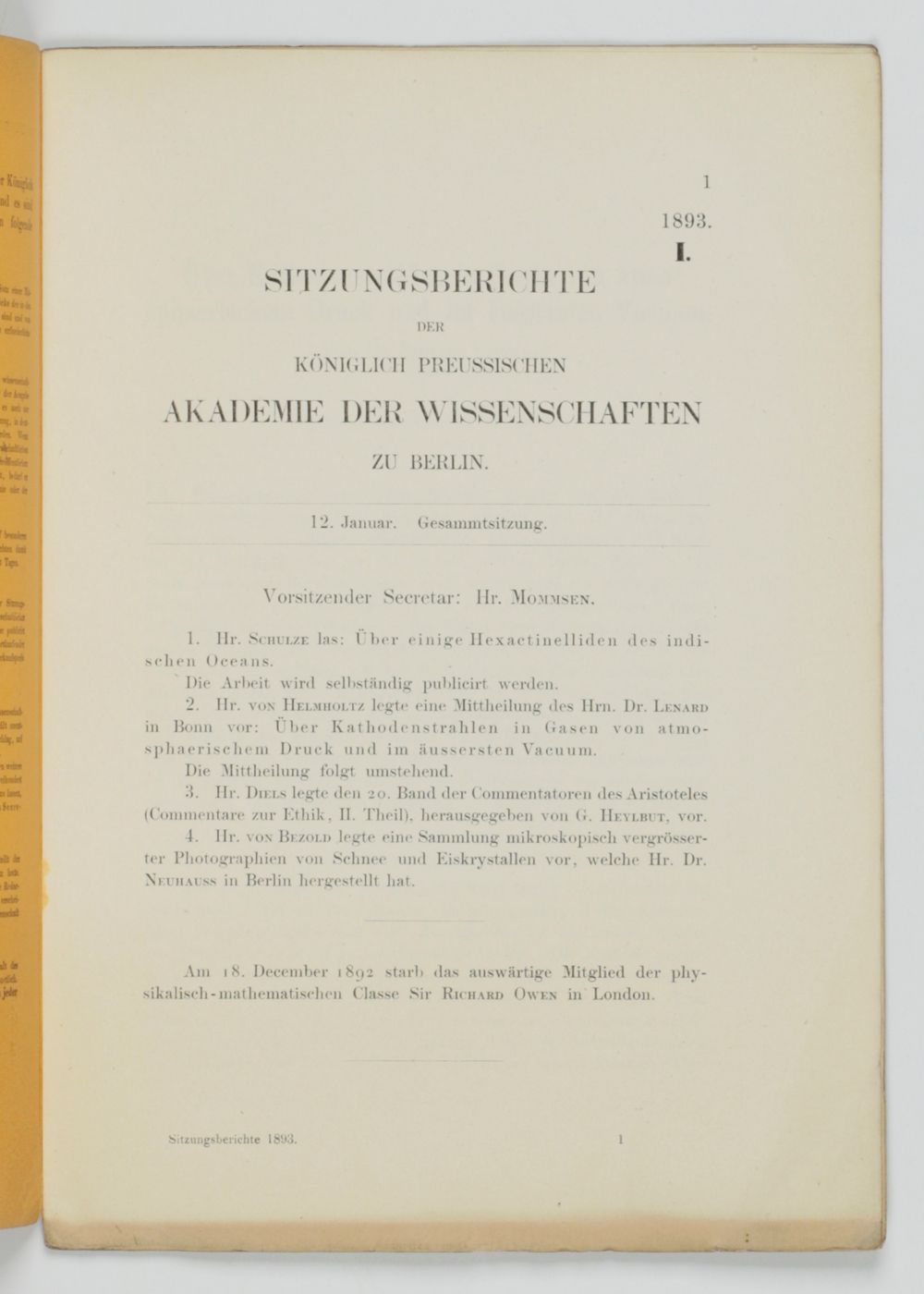
Berlin, Königliche Akademie der Wissenschaften (Georg Reimer), 1893. 8vo (26.5 x 19.0 cm). 5 pp. [numbered 3-7]. Original printed wrappers.
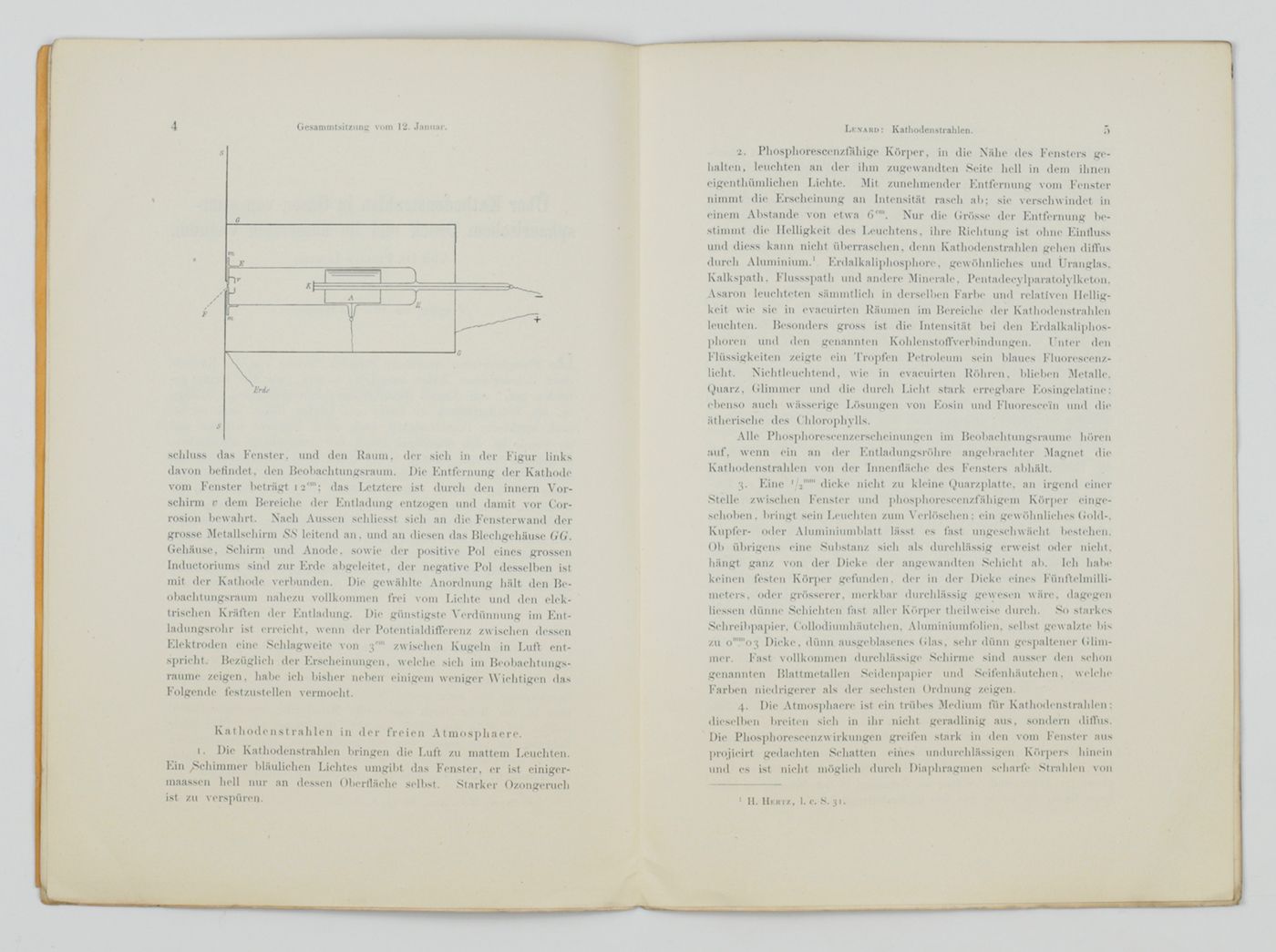
A very important contribution to physics (which contributed to him becoming a Nobel laureate in 1905) conceived and written by the German physicist Philipp Eduard Anton von Lenard (1862-1947). "As a physicist, Lenard's major contributions were in the study of cathode rays, which he began in 1888. Prior to his work, cathode rays were produced in primitive, partially evacuated glass tubes that had metallic electrodes in them, across which a high voltage could be placed. Cathode rays were difficult to study using this arrangement, because they were inside sealed glass tubes, difficult to access, and because the rays were in the presence of air molecules. Lenard overcame these problems by devising a method of making small metallic windows in the glass that were thick enough to be able to withstand the pressure differences, but thin enough to allow passage of the rays. Having made a window for the rays, he could pass them out into the laboratory, or, alternatively, into another chamber that was completely evacuated. These windows have come to be known as Lenard windows. He was able to conveniently detect the rays and measure their intensity by means of paper sheets coated with phosphorescent materials [This paper]. Lenard observed that the absorption of cathode rays was, to first order, proportional to the density of the material they were made to pass through. This appeared to contradict the idea that they were some sort of electromagnetic radiation. He also showed that the rays could pass through some inches of air of a normal density, and appeared to be scattered by it, implying that they must be particles that were even smaller than the molecules in air. He confirmed some of J. J. Thomson's work, which eventually arrived at the understanding that cathode rays were streams of negatively charged energetic particles. He called them quanta of electricity or for short quanta, after Helmholtz, while Thomson proposed the name corpuscles, but eventually electrons became the everyday term. ...Lenard grew extremely resentful of the credit accorded to Wilhelm Röntgen, who received the first Nobel Prize in physics in 1901, for the discovery of the X-ray, ... Lenard wrote that he, not Roentgen, was the “mother of the X-rays,” since he had invented the apparatus used to produce them. Lenard likened Röntgen’s role to that of a “midwife” who merely assists with the birth. ...Lenard is remembered today as a strong German nationalist who despised 'English physics', which he considered to have stolen its ideas from Germany. During the Nazi regime, he was the outspoken proponent of the idea that Germany should rely on 'Deutsche Physik' and ignore what he considered the fallacious and deliberately misleading ideas of 'Jewish physics', by which he meant chiefly the theories of Albert Einstein, including 'the Jewish fraud' of relativity. An advisor to Adolf Hitler, Lenard became Chief of Aryan Physics under the Nazis." (Wikipedia). Published in the academy's Sitzungsberichte, 1893 I, published on 19 January (wrapper date: 12 Januar. Uncut. Slight soiling to wrapper edges, weak, marginal creases; otherwise, a very good, unmarked copy.

Recently Viewed
![image for Ergebnisse der Plankton-Expedition der Humboldt-Stiftung. Die Cephalopoden der Plankton-Expedition. Zugleich eine monographische Übersicht der Oegopsiden Cephalopoden. Hierzu ein Atlas von 48 Tafeln. [The complete Cephalopoda].](https://schierenberg.nl/media/cache/product_thumb/75299/75299_x.jpg)
![image for [Four large plates of Helicidae (s.l.)]](https://schierenberg.nl/media/cache/product_thumb/69767/69767_x.jpg)
![image for Iles Taïti. Esquisse historique et géographique précédée de considérations générales sur la colonisation française dans l'Océanie. Première Partie - Deuxième Partie. [Complete].](https://schierenberg.nl/media/cache/product_thumb/70847/70847_x.jpg)
![image for Catalogue of the birds in the collection of the British Museum. Volume XVIII [18]. Catalogue of the Picariae in the Collection of the British Museum. Scansores, containing the family Picidae.](https://schierenberg.nl/media/cache/product_thumb/71216/71216_x.jpg)
![image for A monograph of the British Jurassic Gasteropoda. Gasteropoda of the Inferior Oolite. Parts 1-9. [Complete].](https://schierenberg.nl/media/cache/product_thumb/78413/78413_x.jpg)
![image for Encyclopedie Methodique. Histoire naturelle des vers. Tome premier. Tome troisième. [Texts].](https://schierenberg.nl/media/cache/product_thumb/78637/78637_x.jpg)
![image for The Percy Sladen Trust Expedition to Lake Titicaca in 1937 under the leadership of Mr. H. Cary Gilson, M.A.. Reports 1-6, VII-XII, XIII-XX. [Complete].](https://schierenberg.nl/media/cache/product_thumb/77064/77064.jpg)